Wednesday, 30 June 2021

Book Review: Timeless Treasures


Infosys Bangalore, the Indian Multinational information technology company is a brand well known not only in India but allover the world in view of its customer base in Europe, Americas, Asia Pacific, Middle East and Africa. It is a highly sought after destination by freshers not only because of the brand  but also for the world class training given to the new recruits at its 350 acre facility in Mysore. It is a place where young freshers come with dreams in their eyes, undergo arduous training requiring long hours of work, grueling work schedules, tests and project work. They need to pass the final examination to be accepted as a regular employee of the company. 

This then is the setting for Padmini Chilappagari's E Book "Timeless Treasures" that featured in the Blogchatter E Book Carnival. The protagonist Priya from Hyderabad  arrives at the campus for training. She feels secure by the fact that two of her close friends from college Myra and Arjun are also with her during the journey. The book takes you on an interesting trip to all the favourite places of Priya  inside the campus, which is known to be an architectural marvel. 

 It also shares the pressures, joy and  fun in the life of trainees for a limited period of a over six months of training   As a person with a corporate background who started his career as a management trainee at VISL Bhadravati and as one who headed the learning and development department in Hyundai monitoring the training journey of new recruits, I can relate to the excitement and challenges discussed in the book. 

I have visited the Mysore campus of Infosys once when I was heading HR In BEML Ltd Mysore . We had gone straight to the venue of our discussion.On the way, we could see young people playing basket ball and other games and the general beauty of a huge campus. We were curious to know about the other structures in the campus and hoped to come back on some other occasion to explore the campus in more detail. However, this never happened and I moved out of Mysore.  "Timeless Treasures" fills up this gap for me giving details of the various food courts (Arena, Magna, Fiesta, Oasis, among others), the dome shaped Multiplex, hostels, amphitheatre, swimming pool, Gym and bowling alleys. 


The book also manages to squeeze in a little bit of romance into the narration and the feelings of the characters involved. I enjoyed reading the chapter " Night strolls and new friends" in which Priya meets other college mates Anusha and Rishi (whom she had never met while in college)  and agrees to go on a stroll of the campus late  in the night after supper. As they discuss of old college times, and move around the sprawling campus, time flies and before they know it, it is 3.30 AM.  

The book also discusses their get away to Chamundi Hills, Coorg and trek to Scandagiri Hills near Bangalore after grueling work schedules/project, involving work of 12 to 14 hours. In the chapter "Treading on thin ice". Priya feels home sick after staying away from family for four months. She gives in to this sudden impulse to travel to Hyderabad during the weekend just before an important/ tough test on Monday. Such indulgences and dare devilry is possible only when you are young and  have not yet lost the 'care free' approach to life. 

The charm of the book is its authenticity. It is written by one who has experienced it all first hand. The author has used a lot of dialogues which adds to the natural flow and appeal of the narration. Little incidents such as feelings of crush that a student feels for her young teacher is narrated, with insight into human nature in these lines:  

"  I was suddenly thrown off by his smile.It was as if his whole face lighted up with his smile.I suddenly became conscious of my disoriented hair.We had jogged all the way to the class and my hair sure looked stupid.I could do nothing about it."  

Although the trainees spent a little over six months at the campus for the training, it is very clear from Priya's narration  that many of them got emotionally attached to the place, they  had difficulty in bidding adieu. As Priya says " The Infosys management was clever in not disclosing our posting locations till the last minute.This kept us all occupied thinking of our posting locations rather than the thoughts of missing the campus."  She adds " We all looked at the campus gates for one last time. But in my case, I couldn't get myself to look at it . If I looked at it another time, I would never be able to leave it."   

" Timeless Treasures" is a pleasure to read. It touches a chord  at places in your mind and body. Yes, there are grammatical pebbles here and there in this feast of a read. But nothing that a third eye (to borrow the word of critic and fellow blogger Yamimi Maclean) cannot address. The strength of the book is its material, the natural/ authentic language of the characters and an interesting setting.

I wish the young author who has a natural flair for writing the very best!   

The book can be downloaded for free Here

 I also participated in the # Blogchatter Carnival 2021

Sunday, 27 June 2021

Double Edged Sword


Branding, a double edged sword

gets noticed initially

creates interest, expectations 

then hyper expectations

and  quality is taken for granted!   


The more the hype created

the more the expectations

short run, big advantages 

long run, big responsibilities 


Failure to deliver tall promises

leads to disenchantment, disappointment  

feelings of betrayal and withdrawal 

soon, the brand faces decimation

disgrace and extermination! 


Beware! Don't over hype, over promise!

play carefully with a double edged sword!    


NB:  I recited this poem during the online 7th Dignagar International Poetry Meet on 27th June 2021.


Saturday, 26 June 2021

Book Review: She and other Poems


The book "She and other poems" by Huma Masood which  featured in the Blogchatter E Book Carnival is unique in the sense each poem has a preamble of a line or a few lines. Although the book contains 33 poems under four sections namely (1) She (2) Dilemma (3) Inspired and (4) Random Thoughts, the poems are short and before you know it, you have completed reading it. It is what you would call "a quick read". Yet, the book will compel you to go back, dwell and look for deeper meaning.

From the preamble to the very first poem "She", you know that the poet is not satisfied with the lot of "She".

" We are like birds in different types of cages 

Few feel free to chirp, hop and fly 

until they collide with the cage confines. Then they know

the limits 

wiser, they spread their wings once again minding not to 

clash with the cage walls "    

The later  poems  also reflect this dissatisfaction and the style is also similar. You do not see anger and indignation expressed in a strong, aggressive manner as many feminist poets are known to do. The poet conveys a kind of quiet resolve that 'fresh beginnings' and realization of 'dream'  will happen as you 'keep going'. 

In the poem "Go Where you can Grow"  she says:   

When you have nowhere to go 

Go barefoot, walk the spiked road 

jump over defining lines 

to go flourish unconfined 

Don't stop to watch the time flow

Go some place where you can grow 

Go to explore paths unknown 

Step beyond your comfort zone  

I particularly liked the poems under the "Random thoughts" section. Look at this three liner called "Autumn" :  

" Fallen leaves that sing 

The glorious songs of spring 

And autumn listens " 


The poem titled "Mirror" goes thus:  

" The mirror reveals it all 

Though many masks screen her soul 

Dark kohl lining her brown eyes 

And mascara that complies 

Paints conceal her milky skin 

But that persistent square chin 

Betrays an obstinate soul 

That none will ever control  

" My heart is an ocean" and "blue is the colour of" are other interesting poems in the section. The desire to travel literally and metaphorically can be observed while reading the book. In the poem "On my Couch", the poet says 

" I read, I indulge

I see the beautiful world

curled up on my couch"    

Simplicity and subtlety is the essence of this book. If you like such a style you will enjoy reading " She and other Poems" which as already mentioned, is a quick read that demands more time to ponder on subsequently. When I recently interviewed  an accomplished poet Pankajam Kottarath, to a question on the modern trend in poetry writing, she replied "Shorter forms of poetry are becoming more popular; brevity and simplicity could rope in  more readers." ( Full interview). The writing style of poet  Huma Masood is in line with the current trend. 

The book is tastefully mounted, very pleasing to the eye and impressively executed with glossy colour background enhancing the value of the content.

The book can be downloaded for free Here

 I also participated in the # Blogchatter Carnival 2021( can access at the link) 

Friday, 25 June 2021

In Conversation with an accomplished, unassuming, self- effacing Poet


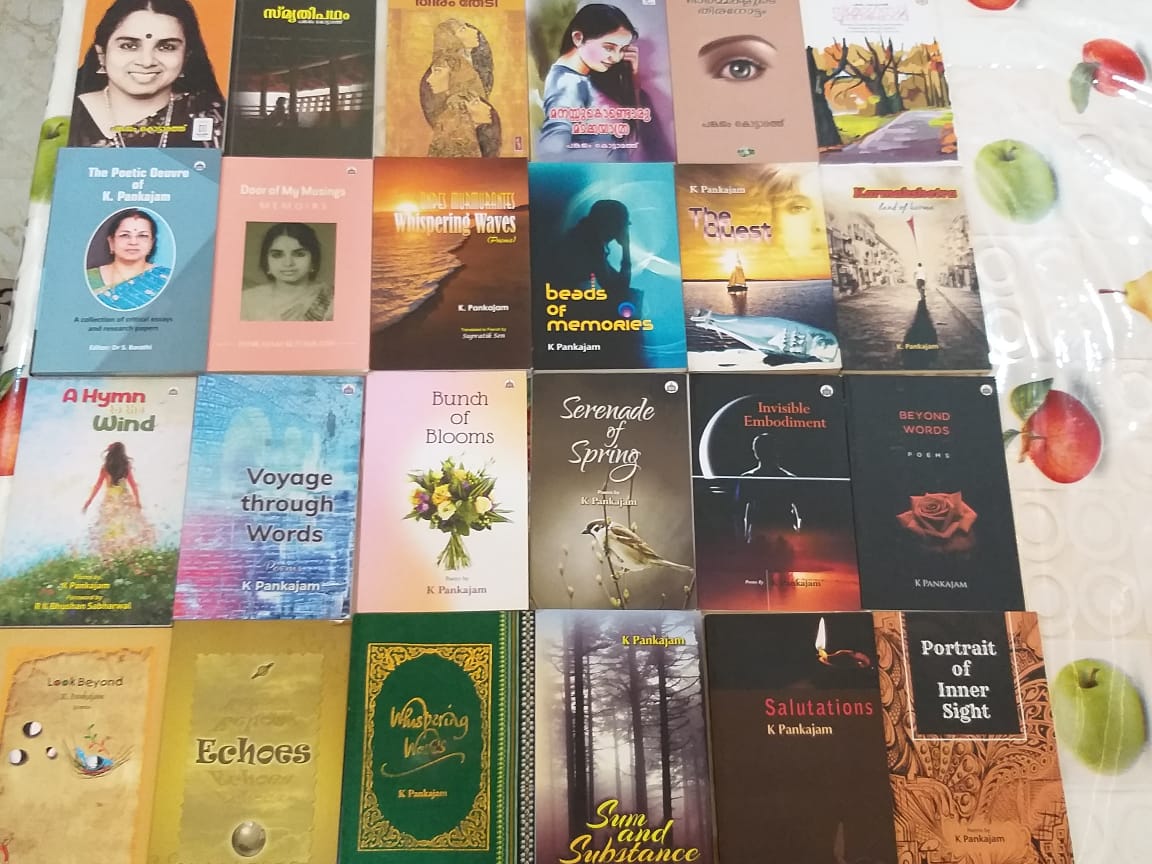
Pankajam Kottarath (K.Pankajam) is a poet whose writing I had enjoyed reading right from the time of  her early works such as "Echoes" and "Whispering waves". Later we were both members of nurturing literary  groups like the online "Rate my literature" and the real time "Chennai poetry circle", where I got the opportunity to read and admire more of her poetry. 

In the meanwhile, Pankajam has travelled great distances. Today she is the author of  25 books (14 of which are poetry) that include fiction, poetry and literary criticism in English and  Malayalam. She has received many awards that include the Rock Pebbles National Literary award 2019. It was a pleasure to catch up and get to know first hand the lady's illustrious poetic journey over the years.

Rajeev Moothedath (RM) : Warm greetings Pankajam!  I am so happy you agreed to this conversation.

Pankajam Kottarath(PK) : Thank you Rajeev. Happy to talk to you, anytime. 

RM:  let us start at the very beginning, Could you tell us a little about your place of birth and family background?  

PK:  I am from Manalur village in the Trichur district of Kerala, that has a landscape of backwaters on two sides and vast paddy fields silhouetted by mango and coconut groves on another side.  Ours was a conservative middle class family. My father was a teacher; my mother a great devotee of Lord Krishna. She used to worship the Lord on the first day of every month at Guruvayur temple. I used  to tag along clinging to her saree on such trips. It was her daily routine to read Ramayana and Mahabharata with a unique rhythm of her own. I think all these have influenced me and  unconsciously crept  into my writing later on. 

RM:  That is interesting. Are there other incidents that molded your life in general and writing in particular? 

PK:  I lost my mother when in her early forties. Perhaps, as they say God calls back early those who are more dear to him. I had lost my father two years prior. This meant being the eldest, the care of my three younger siblings fell in my inept hands. At that time I was only seventeen and married as well. I thank God for blessing me with enormous patience, perseverance and a sense of balance that helped me tide over those difficult times. 

RM:  Circumstances required you to play a role of a mature adult with major responsibilities  at a very young age! Would you like to tell us about your education and career? 

PK :  I did my schooling up to PUC in my hometown and later moved  to Chennai to obtain a  degree in  commerce from Madras University. Later, after joining BHEL, I did CAE , PG diplomas in Financial Management and Taxation Laws. 

I am very emotional by nature and value personal relationships above all else. Although I had cleared 9 out of 10 papers in ICWAI groups I & IIthe sudden demise of my best friend and young colleague devastated me to such an extent that I could not continue and complete ICWA.   
  
I retired  as Deputy Manager-Finance from BHEL, Chennai. I have a sense of satisfaction and pride that I completed my official assignments effectively with commitment. Now, retirement leaves me with ample time to pursue my first love- poetry and literature. 

RM:  So when and how did the writing bug bite you?  

PK: Frankly, I really do not know when and how poetry started entering my bonnet; more than one factor seems to have drawn me towards poetry. At my father’s house, there used to be Aksharaslokam recitals in Malayalam in which  my father’s elder brother actively participated. As a child I used to join in these literary gatherings just for fun. 

 Being a sensitive and non vocal person, I found it difficult to express my feelings openly when upset, disappointed or angry about something. Instead of speaking out, I used to put it down on paper and tear it off later . This helped me to ward off negativity. I also started jotting down about things that touched my heart. However, I didn’t feel like showing these deluges to anybody, as I considered them trivial. Finally, I gathered enough courage to submit one of my poems for a poetry contest held by my employer. To my pleasant surprise and disbelief, I won the first prize! The journey had begun;  I published my first book in 2006. 

RM: Why write or rather what motivates you to write?  

PK:  Writing relieves me from monotony and stress, gives me the opportunity to connect with like-minded people. When it comes to poetry, it is a means to convey powerful messages in less number of words. I write poetry from the heart rather than the brain. While providing the opportunity to unleash my wealth of creativity, writing helps to talk of social issues, spread messages of love, peace and universal brotherhood.

RM:  What are your preferred subjects for writing?  

PK :  Well, I am a lover of nature and so many of my poems are on nature. Many of my  poems also deal with  women’s issues. I have also written on themes such as love, relationships, environment, fate of animals, old-age, death etc. I have also written an exclusive book of poems on spirituality. 

RM:  Yes, I also particularly love your nature poems. Could you share with readers your writing process?  

PK I make short notes instantly about the experiences I come across, newspaper reports, social stigmas, a picture that tells a story. Anything that strikes a chord in my consciousness prompts me to write. Often, I am able to write a fully developed poem at a stretch. However, then I keep on editing it till I am satisfied.

RM: You write in English and  in your mother tongue Malayalam. In which language are you more comfortable writing? Writing in which language gives you more satisfaction?  

PK: I am comfortable working in both the languages. My mother tongue Malayalam, the language I grew up listening and talking is dear and close to my heart. However, I also realize that writing in English gives me the advantage of more reach and readership. In short, I love both languages passionately. 

RM:  What are your views on modern trends in poetry? Further, what message would you like to give budding poets starting out on their journey? 

PK:  The current trend in poetry is towards free or open verse. Shorter forms of poetry are becoming more popular; brevity and simplicity could rope in  more readers. I read a lot of  the  works of contemporary poets. The poets of the younger generation are a promising lot. They are bold in their expression. 

To the budding poets I would like to suggest that it would be great if they could write with correctness, conciseness and clarity. Here, Correctness refers to both to the expression and the content; Conciseness to economizing the words and Clarity to clear and logical thoughts. It may be difficult to incorporate these, all at once. 

RM: Now, to my last question. Having achieved so much as a writer, what are your aspirations for the future? 

PK:  I am happy if I continue to share my thoughts effectively and my voice is heard. If my words inspire even a single soul, I would consider myself blessed. It would be great if it makes an impact on readers' mind- create my own niche, even if a small dot in the big canvas of literature.  

RM: That was a very holistic, engaging and fascinating conversation! Thanks a lot Pankajam! 

PK: Thank you Rajeev for having me. I also enjoyed talking to you. 

Wednesday, 23 June 2021

Childhood Memoirs and Fantasy: "and all the SEASONS in between"


I read another book from the list that I had downloaded for reading from amongst those that were featured in the # Blogchatter E Book Carnival. This time,  a part of me asked " This is a book that has been appreciated and reviewed by many. What is the point of one more from you? Forget it Rajeev." 

"I know, I know, I told that part . Yes, there has been rave reviews of the book. One more or less may not make any difference. But, having loved  this book, I can't help expressing my impressions. Okay, okay, I am not writing a review. I will simply give a reader's perspective without wearing  the hat of a reviewer". In any case, I normally read books that interest me;  rarely write about one until it impresses to such an extent. It is blogchatter that has set this juice flowing for giving feedback on books- Thought I would write the mandatory two but found myself writing more. Perhaps I enjoy the process a lot more than I had cared to admit! But this, this is one book on which I simply had to share my thoughts. 

The book " and all the SEASONS  in between" written by Arti Jain comprises of fond childhood memories from the beautiful  hills of Dehradun that encompasses characters from a joint family, particularly the author's grandparents, Papaji and Beji. I have previously confessed to readers that I am a sucker for memoirs, simply love reading them for the nostalgia they evoke. In Arti's  book, it is not only the lovely memories of childhood (best period) but a concoction of fantasy and exquisite natural surroundings- papaji's garden, the grand house with courtyards, the guava tree, dragon fly are all interesting and important parts/ characters of the narrative.   

During the challenge, I came across the writing of the author quite late when I read the last chapter "He carried dirt under his finger nails" where we got introduced to Papaji and his deep love for his miiti/ earth/garden and his grandchildren - He fed them a few morsels of food personally with a lot of love. In fact, he felt he was ready to have a hearty meal himself only after his darlings have had their fill. A man of the soil, he did not see 'mitti' as dirty- He points out to the children, the earth, me and you are all made of the same substance. 

Reading this chapter, one cannot but be hooked by a desire to know more. I had made up my mind then and there that I would read the whole book when it is ready. The chapter also reveals how much Papaji missed the land of his birth "Shinkiari" across the border. A sad feeling envelops the reader as he reads about the "land that was snatched away from him by a line drawn in pen by mortal men." 

Let me share with you some of the random lines that I enjoyed reading from the book :  

  • Time, when you are in a garden with your grandfather melts like ice cream in the hot sun. 
  • Joint families are like jalebis: Complex and complete, crunchy and sweet. 
  • He whispered to each radish as he poured a little milk down into its soil bed.
  • They must be telling sky all about two girls lying with their mother in a field of wild flowers with an owl for company.
  • Understanding comes to those who sit still. 
  • We never ever cut or sliced Chaunsa (mango) with a knife- sucked the juice through the little puncture we had created-  (This sounded like the Chandrakaran mango of Kerala! )
  • The juice of Chaunsa in the meanwhile, found their way down to our elbows, trickling down our cheeks and throats in golden orange and sticky rivulets. 
  • Love had a way to nourish without side effects. Beji knew this instinctively.
  • My child, friends come in different shapes and sizes 
  • He picked one (chestnuts) , peeled it and popped it in our waiting mouths - turn by turn, like a bird feeding its fledglings. 
  • Very early in my life, I realized that songs and stories, recipes and riwaz (traditions) and remembered memories are the treasures my grandparents were able to bring over from across the border with them.     

Readers will also enjoy episodes of  tree climbing adventures, relatives visiting with an intention to steal the lip smacking recipes of Beji, the author's early morning 'pheri' with Papaji on a chilly October morning and many more!  If you pay attention, are willing to read between the lines amidst the fun and frolic, you get some life lessons as well- "Artemis,you should talk to the dragon fly. I can see you miss her. Open your heart and hear her out."  The book has a beautiful cover page and arresting illustrations through out the book which has been done by Arshia Jain, author's daughter. 

This mesmerizing book can be downloaded for free here

 I also participated in the # Blogchatter Carnival 2021( can access at the link) 

Saturday, 19 June 2021

കോറോണയും, നമ്മുടെ സമീപനവും


I wrote this poem for reciting at the June month meeting of the Kavya kaumudi International Multilingual poets meet held on 19/6/2021.It is a translation of my poem in English "Professionally Surviving a pandemic". The original can be read here

എവിടെ നോക്കിയാലും അനിശ്ചിതത്വം 

എന്റെ ജോലി നിലയ്ക്കുമോ ? എത്ര കാലം ? 

കിട്ടാതെ പോയ പ്രൊമോഷൻ എപ്പോൾ കിട്ടും ? 

ഈ മഹാമാരിയെ ഞാൻ,  അതിജീവിക്കുമോ ?            


ജോലിക്കു നേരിട്ട്, പോകേണ്ടി വരുന്നതിനുള്ള, അരക്ഷിതതത്വം 

ഓൺലൈനിൽ ചെയ്യുമ്പോളുള്ള അരക്ഷിതതത്വം 

പല ഉത്ക്കണ്ഠകളും, ഭയമായ് മാറുന്നു ... 


സ്വയം പ്രചോദനമായ്‌, നിന്ന് കൊണ്ട് 

മറ്റുള്ളവർക്ക്, പ്രചോദനമേകാം മിത്രരേ

ഈ കാലത്തെ തരണം ചെയ്യാൻ, വേണം 

ആത്മ നിർഭാരതയും സമതുലതാവസ്ഥയും

ഇതും കടന്നു പോകും ... 


ഈ സമയം, സദുപയോഗിക്കാം 

വളർത്തീടാം, നം  കഴിവും ജ്ഞാനവും 

കോഴ്സുകളിൽ ചേരാം 

സെർറ്റിഫിക്കേഷൻസ് കാരസ്ഥമാക്കാം 

കോറോണക്ക് പിമ്പുള്ള, നം ജീവിതം, പുഷ്ടി  പെടുത്താം ! 


ഇതും കടന്നു പോകും 

പ്രകൃതി നീതിക്ക്അനുസൃതമായ് 

കോറോണയും മാഞ്ഞു മറയും 

ഇരുളിന് ശേഷം അവസാനം 

ജ്യോതി പ്രത്യക്ഷ പെടുക തന്നെ ചെയ്യും ... 


രാജീവ്  മൂത്തേടത് 

NB: (1) ഇത് എന്റെ ഇംഗ്ലീഷ് കവിത "Professionally surviving a pandemic" ന്റെ  മലയാള പരിഭാഷയാണ് .
       (2) ഈ കവിത കാവ്യാ കൗമുദി ഇന്റർനാഷനലിന്റെ ജൂൺ മാസ മീറ്റിൽ ഞാൻ ചൊല്ലുക ഉണ്ടായി .


Thursday, 17 June 2021

An Enchanting, Intriguing and Exciting Journey into the Past


During the A2Z challenge 2021 organized by Blogchatter, even as I was busy participating, I took  time to quickly read the posts of fellow bloggers. As you enjoy reading them, you realize there are a couple of  topics given their content and depth, need to be read in a focused manner devoting a lot more time to them. "The beauty of Sanskrit Language and Texts" written by Durga Prasad Dash is one such book that I took my time to read and now have the pleasure to review. In his foreword, the author has made clear his intention to discuss various genres of literature in the language as there is a general perception that Sanskrit literature is all about spirituality.  

Starting with a chapter on the immortal lexicon/dictionary or the Amarakosha compiled by the writer Amara, the book  goes on to discuss diverse subjects such as literature (Bhaja Govindam, Gita Govindam,  Kamasutra, Mrichakatikam to name a few), holistic health (Charaka samhita), legal provisions on women's empowerment (Dayabhaga), guidelines on body postures and breathing exercises (Hatha yoga pradeepika), astrology/astronomy (Jyothisha), contribution to mathematics ( Ones and zeroes), Tharka sasthra (the culture of the argumentative Indian) , various types of vidya (knowledge) and many more! 

This is a book that is educative, informative and entertaining at the same time giving us plenty of small snippets from the life of yore. Let us look at some of them: 

  • Verses are easier to remember; Charaka Samhita ( Treatise on holistic health) has detailed prescriptions which can be easily recalled by the vaidya (doctor) as it is in verse. 
  • While giving prescriptions, Charaka Samhita gives equal importance to preventive health- examines physical, psychological and spiritual sources of diseases and well being.  
  • Women's right to inheritance has been compared and contrasted between Bengal & Assam on the one side (Dayabhaga school of thought) and the rest of India (Mitakshara school). Even in those times viz 11th century India, the Dayabhaga school recognized the right of widow to inherit husband's property.
  • The Upanishads contains discussions about the reality and the ultimate goals of human life. Since they come towards the end of the vedas, they are also known as vedantas. Information is given in more detail about the Eesha Upanishad while providing basic information about other upanishads and all the sources of knowledge and information of ancient times including Ithihaasa, Purana and texts pertaining to development of skills such as Natya (dance),  Vaastu (property), krishi (agriculture), Shilpa ( Sculpting) etc. 
  • The book also enlightens us about the plays of those times which were mostly written in verses. The author has picked up works of writers other than the famous Kalidasa for discussion so that readers get to know of other writers such as Sudraka and Bhasha. After reading the chapter on the play Mrichakatikam"  the reader will be enthused to check out the film version "Utsav" Starring Rekha, Shekar Suman and Shashi Kapoor for its interesting story line, twists and turns.
 Although I had seen it when it was first released in 1984, I look forward to watching it once again on you tube. One lesser known work of Kalidasa with a unique theme Ritu Samhara is included in the book providing information on the various flowers that bloomed in ancient India during the six seasons. 
  • Those interested in the regaling stories of Panchatantra can get more information in the book. I was happy to learn that Chandamama, a children's magazine that used to publish these stories when we were growing up is back with a website where you can get access to all of those old issues. 
  • We get to read about the Kamasutra of sage Vatsyayana (400 BC- 300 AD) that discusses two types of Kama- the ordinary and the special and is also very revealing in the sense it is interesting to note that our ancestors were lot more liberal in their approach to sex and its practice as a science. 
  • The diverse subjects discussed in this  short book is mind boggling. Even as art, health, seasons etc. are discussed, the chapters on Uddhava Gita, Yog Vasishta and Varieties of Vidya discuss  more serious aspects of life such as pursuing 'Para' Vidya, a knowledge beyond /developing higher consciousness. It does not mean 'Apara' vidya, knowledge about worldly needs is not addressed as  we discussed earlier in this post.   
  • It is after reading the book that I came to know that the  'Sutra' is a cryptic statement/ telegraphic comment which is both its strength (could be written easily on the leaves at that time)  and limitation (need help from an expert to understand). similarly, I became aware of the role of 'Stuti'  (verses in praise of deity) in providing positive auto suggestions that can create positive vibes in a person even without him/her being aware of it.     

 "The beauty of Sanskrit Language and Texts" was for me a very comprehensive book that took me on an enchanting journey into the past on returning from where I feel more enlightened, informed and proud of our country's contribution in various fields since ancient times. The author has done a big service in that youngsters can now get reliable, balanced information on a very important subject. Most information these days are from the What's app university, half baked, evoking jingoism rather than a quiet, dignified pride. 

To my mind, every Indian should be reading this book. The author has successfully achieved what he set out to do, dispel the ignorance and bring alive for the readers  " the beauty, vastness and depth of the Sanskrit language and literature"  

You can download the book for free Here  

I also participated in the # Blogchatter Carnival 2021( can access at the link)